The war really happened
EmuWars is a comedy. Everything in the first act happened. The 1932 operation, remembered since as the Great Emu War, is the whole of it. In November 1932 the Australian military went into the Western Australian wheatbelt with two Lewis guns and 10,000 rounds, spent a month there, and withdrew with the birds still eating. Act I of the campaign takes its incidents straight from the record: the jam at the dam, the gun bolted to a truck, the questions in Parliament.
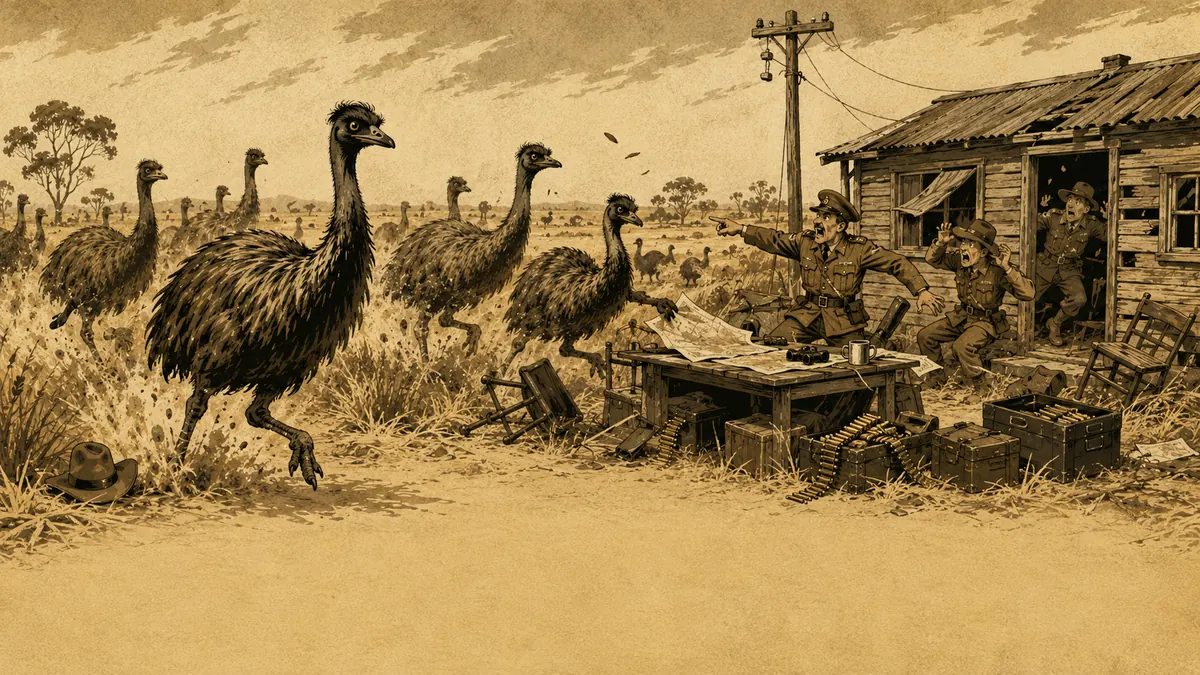
Day 9: the Lewis gun jams. The emus do not.
What happened
Winter 1932
Around 20,000 emus move inland after breeding season and walk into the Western Australian wheatbelt: newly cleared country, freshly cropped, farmed mostly by ex-servicemen settled there after the First World War. The birds eat the wheat. They also flatten the fences, which lets the rabbits in behind them.
October 1932
The farmers write straight to the Minister for Defence, Sir George Pearce. Several of them had worked machine guns in France and knew exactly what to ask for. Pearce agrees to send soldiers and Lewis guns, provided the farmers house them, feed them and pay for the ammunition. The papers are calling it a war before anyone fires.
2 November 1932
Major G. P. W. Meredith of the Seventh Heavy Battery opens up near Campion. The emus break into small groups and run. The guns are sited at range, fire, and hit almost nothing. A handful of birds, on a day that was supposed to settle it.
4 November 1932
A dam near Walgoolan, an ambush, and about a thousand emus walking straight into it. The gun jams after roughly a dozen rounds. Everything still standing leaves at speed.
First week of November 1932
Someone bolts a gun to a truck to run the birds down. Emus do about 50 km/h over rough ground, the tray will not hold still, and the gunner cannot aim from it. Abandoned.
8 November 1932
Questions in Parliament and unkind coverage end the operation. Around 2,500 rounds spent. The kill count is still argued over ninety years later, somewhere between a few hundred and a thousand out of twenty thousand.
December 1932
The farmers push again, so a second deployment goes out. It claims better numbers and still cannot break the population. The military never comes back. The state falls back on paying bounties, which quietly does the job over the next few years.
On the record
"If we had a military division with the bullet-carrying capacity of these birds, it would face any army in the world. They can face machine guns with the invulnerability of tanks."
"The machine-gunners' dreams of point-blank fire into serried masses of emus were soon dissipated."
Where the game departs
History stops in December 1932 with a bounty scheme and a very ordinary ending. From Act II the game follows the question the record leaves lying there instead: if a mob of birds can beat an army once, what exactly is stopping them from doing it again? Twenty-six areas of Australia answer it, east across the continent to Parliament House, with the emus climbing from thrown sticks to captured rifles while the army stays where 1932 left it.
Real people appear only as obvious fictions. Major Meredith becomes Major Reginald Meredith-Smythe, who starts the campaign contemptuous and ends it saluting. The Minister is invented outright.